All Yesterdays will make you love dinosaurs anew. The way we view dinosaurs, and the way that artists have depicted them, has changed greatly over the last century (and even over the last decade). Though a child of the 1980s, my love for dinosaurs started with hand-me-down dinosaur books from the 1960s and 1970s which depicted swamp-dwelling brachiosaurs and bulky, slow-moving biped hunters. At 10 years old my view of dinosaurs was changed forever by Jurassic Park (the book and movie, I was a bit of a JP junkie). Fast moving, sleek, powerful dinosaurs were now all the rage (thanks mainly to lots of paleontological research that my 10 year old self had no idea of!).
And now the shift begins again as, with newer evidence, we've begun to see feathered dinosaurs depicted. Yet... All Yesterdays points out what we are still missing... attempts, however speculative, to see dinosaurs as more than just bones, muscles and skin. Trapped by the near insurmountable lack of evidence of anything but bone and a few skin and feather impressions, scientists and artists have sometimes been guilty of failing to think about how dinosaurs would really have looked and behaved.
There is so much missing from the fossil record that this is quite unsurprising. The end of All Yesterdays presents us with how we might view modern day animals if all we had to go on was their fossilised bones. Darren Naish himself calls it "shrink wrapping" and gives a few examples on his blog here. Once you've let those imagines sink in you begin to see just how different dinosaurs probably actually looked compared to how we've been depicting them.
All Yesterdays presents fluffy dinosaurs, feathered dinosaurs that look like birds rather than feathered scaly dinosaurs, dinosaurs in extreme camouflage (their version of a plesiosaur [not a dinosaur I know!] lying silently on the sea floor disguised as coral is my favourite depiction of a marine reptile ever) and dinosaurs at play.
Almost everything in it is completely and utterly speculative. But it slams home just how inhibited and sterile our depictions have been up to now and how much more utterly beguiling the Mesozoic fauna probably was.
Showing posts with label dinosaurs. Show all posts
Showing posts with label dinosaurs. Show all posts
Saturday, 27 September 2014


Wednesday, 6 July 2011
Dinosaur Survival In The Americas?
Previously I've looked at stories of dinosaur survival into the modern era from Africa and Australia. Both interesting if completely bonkers examples of the genre, I now submit for your approval some more stories from the jungles of South America and elsewhere...
 Alavaro Mesquita was a native Amazonian, who claimed to have a saurian encounter on the shore a swamp in the Rio Purús/Rio Juruá area of the Amazon basin. Whilst fishing along the shore he encountered he saw two red eyes high above the ground. Getting closer he saw what he described as a bipedal reptile, most closely resembling a Camptosaurus
He shot at the animal which fled deep into the swamp. He recounted his tale to a skeptical Rolf Blomberg, who was collecting interviews for his 1966 book Rio Amazonas
Another story, a creationist favourite, comes to us from a 1883 letter to the Scientific American called "A Bolivian Saurian,"
A possible overweight Bolivian sauropod (with multiple heads)?
 The fascinating adventurer Percy Fawcett also claimed to have encountered a sauropod, which he claimed was a diplodocus, along the Brazil/Peru border. This sighting occurred during a 1907 expedition on behalf of the Royal Geographical Society to map the border area. Fawcett is worthy of a post all to himself... check out his Wikipedia page and more info here. His son, Brian, later sketched the scene he imagined when he father saw the footprints of this large creature. Note the tail mark dragging in the ground, an artists imagination running away with him as current scientific opinion (and common sense) suggests dinosaurs, especially sauropods, didn't drag their tails!
Another, more detailed, 1907 encounter by Franz Herrmann Schmidt can found here. Reports of this nature by explorers in the Brazil/Peru area in the first half of the 20th century are relatively common. Later in the century we get lots of more recounting of native stories of large Mokele-Mbembe like monsters.
If you think the tales of dinosaurs in the jungles of South America are off-the-wall, just check out some stories from with the United States of America!
Picture of Camptosaurus used under license from FunkMonk
If you feel benevolent and particularly generous, this writer always appreciates things bought for him from his wishlist
 Alavaro Mesquita was a native Amazonian, who claimed to have a saurian encounter on the shore a swamp in the Rio Purús/Rio Juruá area of the Amazon basin. Whilst fishing along the shore he encountered he saw two red eyes high above the ground. Getting closer he saw what he described as a bipedal reptile, most closely resembling a Camptosaurus
 He shot at the animal which fled deep into the swamp. He recounted his tale to a skeptical Rolf Blomberg, who was collecting interviews for his 1966 book Rio Amazonas
Another story, a creationist favourite, comes to us from a 1883 letter to the Scientific American called "A Bolivian Saurian,"
"“Sir,—The ‘Anglo-Brazilian Times,’ March 24th, 1883, says that the Brazilian Minister at La Paz, Bolivia, has remitted to the Minister of Foreign Affairs in Rio photographs of drawings of an extraordinary Saurian killed on the Beni after receiving thirty-six balls. By order of the President of Bolivia the dried body, which had been preserved at Asuncion, was sent to La Paz. It is 12 metres long from snout to point of the tail, which latter is flattened. Besides the anterior head, it has, 4 metres behind, two small but completely formed heads rising from the back. All three have much resemblance to the head of a dog. The legs are short, and end in formidable claws. The legs, belly, and lower part of the throat appear defended by a kind of scale armour, and all the back is protected by a still thicker and double cuirass, starting from behind the ears of the anterior head, and continuing to the tail. The neck is long, and the belly large and almost dragging on the ground. Professor Gilveti, who examined the beast, thinks it is not a monster, but a member of a rare or almost lost species, as the Indians in some parts of Bolivia use small earthen vases of identical shape, and probably copied from Nature.”"
A possible overweight Bolivian sauropod (with multiple heads)?
Another, more detailed, 1907 encounter by Franz Herrmann Schmidt can found here. Reports of this nature by explorers in the Brazil/Peru area in the first half of the 20th century are relatively common. Later in the century we get lots of more recounting of native stories of large Mokele-Mbembe like monsters.
If you think the tales of dinosaurs in the jungles of South America are off-the-wall, just check out some stories from with the United States of America!
In a letter published in the August 22, 1982, issue of Empire Magazine, a Sunday supplement, Myrtle Snow of Pagosa Springs, Colorado, wrote that in May 1935, when she was three years old, she saw "five baby dinosaurs" near her hometown. A few months later a local farmer shot one after it took some of his sheep. "My grandfather took us to see it the next morning," she said. "It was about seven feet tall, was gray, had a head like a snake, short front legs with claws that resembled chicken feet, large stout back legs and a long tail."So as always no evidence (surprisingly the Bolivian Saurian's corpse has never been located!), but plenty of explorers tales!
But these were not her only sightings. There were two more: (1) "1 saw another one in a cave in 1937, but it was dark green." And (2) "On October 23, 1978, as I was returning from Chama New Mexico, about 7:30 P.m., in a driving rain, I saw another one going through the field towards the place where I had seen the one in 1937."
In 1934 a South Dakota farmer claimed that a giant, four-legged reptile forced his tractor off the road before disappearing into nearby Campbell Lake. Investigators found huge tracks on the shore. Prior to this sighting sheep and other small animals had been disappearing mysteriously. Source
Picture of Camptosaurus used under license from FunkMonk
If you feel benevolent and particularly generous, this writer always appreciates things bought for him from his wishlist
Saturday, 20 February 2010
The Ropen: Another Prehistoric Survivor?

Oh, and also, I must do my usual public service announcement: pterosaurs are not dinosaurs.
With that out the way... let us begin.
The Ropen is a flying creature reported from Papua New Guinea, specifically Umboi Island. Described as having a large wingspan, a large protuberance from the back of it's head and a long tail which is also supposed to glow. These features (except maybe the glowing tail!) lead many to believe the Ropen to be some sort of pterosaur.
Duane Hodgkinson, now a flight instructor in Livingston, Montana, in 1944 was stationed near Finschhafen, in what was then called New Guinea. After he and his buddy walked into a clearing, they were amazed as a large creature flew up into the air. The men soon realized that it was no bird that started to circle the clearing. It had a tail “at least ten to fifteen feet long,” (book Searching for Ropens, 2007) and a long appendage at the back of its head: apparently, a live pterosaur.Ropens also has plenty of local's own eyewitness accounts and also some "objective" study of these reports can be found here.
Jonathan Whitcomb, a forensic videographer, interviewed Hodgkinson, in 2004, and found his testimony credible. In 2005, Garth Guessman, another experienced ropen investigator, video-taped his own interview with Hodgkinson and the session was analyzed by Whitcomb, who became even more convinced the World War II veteran was telling the truth: The man had seen a ropen. Source: Ropens
There are some videos out there such as this tourists film, some interviews and info films here and an elusive video by Paul Nation which featured a series 3 episode of MonsterQuest. That video shows two lights in the night sky, which I think look artificial but others have different opinions.
Is there really any chance of there being undiscovered creatures in Papua New Guinea. Erm... quite a big chance actually. Papua New Guinea still has uncontacted people, and is one of the places where new zoological (and botanical) discoveries are occurring at an awe inspiring rate. If there is any chance of something that's very large and land or air based being discovered, then one of the most probable places for it to be found is in eastern Indonesia and Papua New Guinea.
 I don't get the feeling that people are making these stories up. That doesn't mean I believe that the ropen is a real, undiscovered species of animal. My main problem is the way it is being used to further a Christian/creationist agenda, especially considering there is nothing for them to gain by discovering a live pterosaur descendant in proving the existence of God or intelligent design.
Check out some of sources out there about this, there is plenty of interesting material. But try not to confuse the Ropen with Rodan.
Further Reading
Searching for Ropens: Living Pterosaurs in Papua New Guinea
 Jonathan Whitcomb
The Pterosaurs: From Deep Time
 - David M. Unwin
If you feel benevolent and particularly generous, this writer always appreciates things bought for him from his wishlist
Saturday, 30 January 2010
Dinosaurs Are Alive
Over a year ago I wrote The Last Dinosaurs, a post stating quite clearly that I don't believe dinosaurs (as in the order dinosauria) have managed to survive in a recognisable form into the modern era. Birds are the closest we are going to get.
But there are still a few interesting stories that I've seen since then that should be put out there for consideration. Tales of sauropods and other quadrupedal dinosaurs are two-a-penny in cryptozoology. But theropods, two legged dinosaurs such as Tyrannosaurus Rex, are a little less common and all the more intruiging for it. Could there really be giant bipedal dinosaurs stalking our planet still?

The Burrunjor
Although I'd obviously previously heard of the most famous Australian reptilian anamoly; Megalania (I type this sitting in a chair with one of Megalania's relatives Mr Gibbs The Bearded Dragon lying on my chest) I'd never heard of a Burrunjor. It would appear there is another giant beast stalking the outback.
From Rex & Heather Gilroy's book Out Of The Dreamtime:
Kasai rex
Reports regarding this mysterious creature seem to have been duplicated and names confused. Supposedly the story originated in the Rhodesia Herald in 1932 with a story regarding the exploits of a Swede named John Johnson (in other versions he is J. C. Johanson)
With just one report I think we can safely put this one down as a "hoax".
So there are two more dinosaur survival stories for you to feast on. Enjoy!
Further Reading
Mystery in Acambaro: Did Dinosaurs Survive Until Recently? Charles Hapgood
Claws, Jaws and Dinosaurs - Kent Hovind and William Gibbons
Mysterious Australia by Rex Gilroy
If you feel benevolent and particularly generous, this writer always appreciates things bought for him from his wishlist
But there are still a few interesting stories that I've seen since then that should be put out there for consideration. Tales of sauropods and other quadrupedal dinosaurs are two-a-penny in cryptozoology. But theropods, two legged dinosaurs such as Tyrannosaurus Rex, are a little less common and all the more intruiging for it. Could there really be giant bipedal dinosaurs stalking our planet still?

The Burrunjor
Although I'd obviously previously heard of the most famous Australian reptilian anamoly; Megalania (I type this sitting in a chair with one of Megalania's relatives Mr Gibbs The Bearded Dragon lying on my chest) I'd never heard of a Burrunjor. It would appear there is another giant beast stalking the outback.
From Rex & Heather Gilroy's book Out Of The Dreamtime:
Campfire stories substantiating Aboriginal claims are commonplace across the far north. Back in 1978, a Northern Territory busman and explorer, Bryan Clark, related a story to me of his own that had taken place some years before. While mustering cattle in the Urapunji area, he became lost in the remote wilderness of that part of Arnhem Land. It took him three days to find his way out of the region and back to the homestead from where he originally set out.He had not known at the time, but his footprints had been picked up and followed by two Aboriginal trackers and a mounted policeman. On the first night of their search they camped on the outskirts of the Burrunjor scrub, even though the two trackers protested strongly against doing so. The policeman hobbled his horse, cooked their meal, then climbed into his swag and went to sleep.Later that night the two Aborigines shouting intelligibly and grasping for their packs and saddles suddenly woke him up. The policeman also realised at this moment that the ground appeared to be shaking. Hurriedly getting to his feet, he too gathered up his belongings, and shortly afterwards, the three galloped away. As he told Bryan Clark later at the Urapunji homestead, he had also heard a sound, somewhat like a loud puffing or grunting noise, certainly loud enough to be coming from some large animal. When asked if he intended to include this incident in his report, he replied he would not because he feared no one would believe him. The policeman warned Bryan never again to return to that area, because if he got lost there again he’d be “on his own”, as he would not come looking for him!
The region’s cave art, thousands of years old, depicts these monstrous animals. Many Aborigines believe these monsters wander back and forth across the Gulf country and Cape York to this day. Back in 1950, cattlemen lost stock to some mysterious beast that left the mutilated, half-eaten remains of cows and bulls in its wake over a wide area, stretching between the border country and Burketown. Searchers on horseback found huge reptilian tracks of some bipedal-walking beast. They followed these three-toed tracks with their cattle dogs through some rough jungle terrain until they entered swampland beyond which was more dense scrub. However, it was at this point that the cattle dogs became uneasy and ran off. The horses were also uneasy and obviously did not want to cross the swamp. While most of the cattlemen decided their animals knew best, two men set off on foot with their carbines. The story goes that they soon came across further tracks in an open area beyond the swamp. While his mate searched about, the other man briefly spotted the dark form of an enormous creature, perhaps 30ft in height, further off in dense timber. The men left the scene in haste.
Johnny Mathews, a part-Aboriginal tracker, claimed to have seen a 25ft tall bipedal reptilian monster, moving through scrub near lagoon Creek on the Gulf coast one day in 1961. “Hardly anyone outside my own people believes my story, but I known what I saw”, he said to me in 1970.
In 1985 a 4-wheel drive vehicle and it s family of travellers, the Askeys, heading for Roper River Mission, happened to take a back road for some sightseeing. Just before they were to pull up and turn around to resume their journey to the mission, they all saw, moving together across an open plain some distance away, two bipedal-walking reptilian creatures a good 20ft tall respectively. “The monsters were a greyish-brown colour and dinosaur-like in appearance. We didn’t wait around”, said the father, Mr Greg Askey.I certainly think there is a lot more "evidence" for this creature than for the slightly more famous story which is to follow, but I still think we must be wary. Australia is certainly massive and whilst it may have over 20 million inhabitants, this is a drop in the ocean considering the size of the continent. However could something large really escape the attention of science for so long? I think it is interesting that the aborigine population have legends that back up the story but aborigine's know no more about the outback than many other Australians nowadays and thus I don't think we should suddenly start to accept all their beliefs and folk tales as fact.
Kasai rex
Reports regarding this mysterious creature seem to have been duplicated and names confused. Supposedly the story originated in the Rhodesia Herald in 1932 with a story regarding the exploits of a Swede named John Johnson (in other versions he is J. C. Johanson)
On February 16 last I went on a shooting trip, accompanied by my gunbearer. I had only a Winchester for small game, not expecting anything big. At 2 p.m. I had reached the Kasai valley (sic).
No game was in sight. As we were going down to the water, the boy suddenly called out "elephants". It appeared that two giant bulls were almost hidden by the jungle. About 50 yards away from them I saw something incredible - a monster, about 16 yards in length, with a lizard's head and tail. I closed my eyes and reopened them. There could be no doubt about it, the animal was still there. My boy cowered in the grass whimpering.
I was shaken by the hunting-fever. My teeth rattled with fear. Three times I snapped; only one attempt came out well. Suddenly the monster vanished, with a remarkably rapid movement. It took me some time to recover. Alongside me the boy prayed and cried. I lifted him up, pushed him along and made him follow me home. On the way we had to transverse a big swamp. Progress was slow, for my limbs were still half-paralyzed with fear. There in the swamp, the huge lizard appeared once more, tearing lumps from a dead rhino. It was covered in ooze. I was only about 25 yards away.
It was simply terrifying. The boy had taken French leave, carrying the rifle with him. At first I was careful not to stir, then I thought of my camera. I could hear the crunching of rhino bones in the lizard's mouth. Just as I clicked, it jumped into deep water.
The experience was too much for my nervous system. Completely exhausted, I sank down behind the bush that had given me shelter. Blackness reigned before my eyes. The animal's phenomenally rapid motion was the most awe-inspiring thing I have ever seen.'
I must have looked like one demented, when at last I regained camp. Metcalfe, who is the boss there, said I approached him, waving the camera about in a silly way and emitting unintelligible sounds. I dare say I did. For eight days I lay in a fever, unconscious nearly all the time.'Now based on this report, even if it was real which I very much doubt, there is nothing here to suggest this is a Tyrannosaurus. The creature is referred to as a lizard and no remarks are made about it hunting on two legs or in fact even standing up on them. So alas I don't think we have two legged carnivorous dinosaurs roaming about the Congo.
With just one report I think we can safely put this one down as a "hoax".
So there are two more dinosaur survival stories for you to feast on. Enjoy!
Further Reading
Mystery in Acambaro: Did Dinosaurs Survive Until Recently?
Charles HapgoodClaws, Jaws and Dinosaurs
- Kent Hovind and William Gibbons Mysterious Australia
by Rex GilroyIf you feel benevolent and particularly generous, this writer always appreciates things bought for him from his wishlist
Thursday, 23 October 2008
The Last Dinosaurs
Imagine, you are hiking through the undergrowth of some far distant jungle. As you concentrate on not tripping over or sinking into the mud, you nonchalantly brush aside an oversized leaf in your way and, after regaining your balance as you nearly fall over a cliff, you see there before you a valley that takes your breath away... and it's beauty is not the only thing causing you to gasp... for there rising above the trees is the long, unmistakable neck of a sauropod.
Fantasy? Or could members of the superorder Dinosauria have survived into the modern day to share this world with their successors the mammals and the birds?
 Christian Craziness? Erm... yes.
According to our current understanding of natural history the dinosaurs, along with many other orders of animals such as the pterosaurs, died out about 65 million years ago. But some claim that not only did they not die out but that they continued to live through to, at the very least, the "recent" past or even to this day. And a few even claim to have encountered creatures they have identified as dinosaurs.
What's the evidence?
Dragons are often proposed as incorrectly identified dinosaurs. Could our ancestors stories of giant reptilian monsters be based upon early humans encounters with the last remnants of a surviving population of dinosaurs?
 It wasn't an asteroid! Did St. George hunt the dinosaurs into extinction?
The idea is beguiling, but there is far more evidence of a different understanding of the origins of dragons. For instance the heraldic dragon (i.e. the stereotypical dragon which could easily pass for a badly drawn dinosaur) is NOT what a dragon of British folklore was originally meant to look like. In fact almost all dragon myths were based on giant worm like creatures such as the Lambton worm. It was only later that British dragons were reimagined as having legs and appearing as we now know them. This image was aided by the use of dragon imaginary to symbolise the superiority of Christianity over pagans (dragons) by the Christian authorities in the early years of the Christian church on our islands. But the British Isles were not alone in believing in dragons, dragon myths appear from around the world. Hmm... surely if dinosaurs were so widespread within such recent times would there not be more evidence of their existence? But there are no modern bones, footprints nor any evidence whatsoever of these ancient encounters with dinosaurs.
Perhaps, just perhaps, people finding fossils of dinosaurs may have been so impressed that they invented the dragons to explain these finds. But more likely the dragon was the UFO of it's day. It is known many societies considered the sighting of anything unusual (such as lights in the sky) to be indicative of the presence of dragons.
Kent Hovind, a former evangelist creationist and current inmate of Federal Correctional Institution Edgefield in South Carolina, is a keen proponent of dragons. He suggests they were simply killed off by humans along with all the other megafauna whereever we settled. Hmm... but we have evidence of the other megafauna, why is there no physical evidence of dragons during that same time period? Of course that's not a problem for him, he thinks the whole world is only 6000 years old. He claims that prehistoric paintings and ancient pottery designs are evidence of dinosaur contact. This is a sort of backhanded insult towards our ancestors. Do people really not believe that they had imagination, and creativity equal to our own? Why is it we believe ourselves to be able to comprehend abstract concepts but everything our ancestors did is interpreted literally? Our ancestors were just as intelligent as we are today. That's why we are here. Plus he keeps calling pterosaurs and plesiosaurs "dinosaurs". That annoys me. It's fine to call them dinosaurs for shorthand purposes in casual conversation. But if you are going to have a lecture about dinosaurs and related prehistoric orders it'd be nice to refer to them by their "kinds" as he insists on doing for everything else, using that stupid childish term. Check out one of his lectures on dinosaurs below, for entertainment purposes only!
But despite my quick dismissal of dragons, people still claim to encounter them. There's a couple of pictures here. But whether you believe those sightings or not, a flying dragon is not a dinosaur. A flying dinosaur is called something quite different, which we will come to at the end...
So have there been any sightings of actual dinosaurs? Well of course there's mokele-mbembe. Reports come from western Africa of a large long necked creature whose tracks are round. What could it be? Some believe it to be a dinosaur.

Whilst locals have been talking about mokele-mbembe for a long time the first European to reference it was probably a French missionary working along the Congo river named Abbé Lievain Bonaventure. He reported that he encountered footprints which he says was created by something that ""must have been monstrous: the marks of the claws were noted on the ground, and these formed a print about three feet in circumference."
Other than sightings that were heard about or tracks that were seen by European adventurers the first time someone claimed first hand to have seen the mysterious creature was in 1932. Zoologist Ivan T. Sanderson claimed he observed a creature with a long neck lurch into a river and said it was dark coloured with a head the size of a hippo! That would be a very large animal indeed.
Most reports place it at about 15 to 30 feet (9.1 m) long. That would probably be too small for a long necked animal to have a head the size of a hippo though...
Locals claim several things about the mokele mbembe. They say it eats the flowering liana, that where it lives it clears the area of hippos and crocodiles, and that eating it is a bad idea indeed (thanks to a story of a tribe who killed and ate one and subsequently all died of poisoning).
Many expeditions have been to search for the animal but most have failed either due to not seeing it at all or suffering the usual camera malfunctions.
My problem with identifying mokele-mbembe as a dinosaur is that it stretches credibility too far with little evidence. Could it not just as easily be a member of the Hyracodontidae or some other extinct line? Why do people automatically assume it must be a sauropod dinosaur simply because it has a long neck and tail? Laziness? Giraffes have long necks, and they are mammals. Just because it looks like a sauropod does not a dinosaur make, has no one ever heard of convergent evolution? *Probably not, creationists who are big fans of mokele-mbembe don't believe in evolution after all* Hmm... that of course presumes that the mokele-mbembe exists at all and is not either a made up creature or a misidentified known one.
There are many other African "dinosaurs" such as the chipekwe, the emela-ntouka (elephant killer), Mbielu-Mbielu-Mbielu (the animal with planks growing out of it's back or shorthand for creationists "stegosaurus"), the nguma-monene and the mahamba (supposedly a 50 foot long crocodilian so not really a dinosaur. If anything I've got my fingers crossed for a phobosuchus).
Africa isn't the only place to have remnant dinosaurs... taken from another cryptozoological creationist site
I desperately, desperately want there to be real live dinosaurs roaming the Earth still. But I can see no reason to accept there is when 1) there are no modern bones of dinosaurs (megalania is NOT a dinosaur, so don't try that old one on me!), 2) an ancient form of mammal (something more likely than a dinosaur to exist still, even if it's only slightly more likely) might have the same sort of skin as a stereotypical depiction of a dinosaur and look quite similar, 3) most eyewitness accounts are hearsay and many represent native folklore rather than fact and 4) the world is quite a different place now and if dinosaurs did survive past 65 million years they would look quite different...
Speaking of which... there's a brilliant news story today on the evolution of dinosaurs into birds. The theory that evolution seems to have started even earlier than previously thought seems to be proven in the form of Epidexipteryx. Because bird is just another word for "flying dinosaur". They really do still walk the Earth... and sometimes grace our skies too.
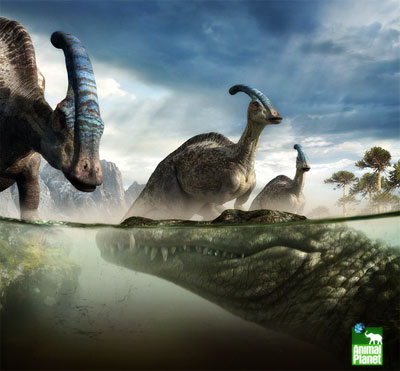
Much of the discussion of dinosaurs in the modern world is generated by creationists who form a significant part of the cryptozoological community. Their hope is that the existence of dinosaurs today would help support their belief in a young Earth. How it would is beyond me... the idea of dinosaurs existing today would not damage the theory of evolution. So for now I shake my head in bemusement at their lack of knowledge of what is and isn't a dinosaur (mosasaur... not a dinosaur) and head off to dream of one day encountering a herd of parasaurolophus. Now that'd be something to behold!
Further Reading
Fantasy? Or could members of the superorder Dinosauria have survived into the modern day to share this world with their successors the mammals and the birds?
 Christian Craziness? Erm... yes.
 According to our current understanding of natural history the dinosaurs, along with many other orders of animals such as the pterosaurs, died out about 65 million years ago. But some claim that not only did they not die out but that they continued to live through to, at the very least, the "recent" past or even to this day. And a few even claim to have encountered creatures they have identified as dinosaurs.
What's the evidence?
Dragons are often proposed as incorrectly identified dinosaurs. Could our ancestors stories of giant reptilian monsters be based upon early humans encounters with the last remnants of a surviving population of dinosaurs?
 It wasn't an asteroid! Did St. George hunt the dinosaurs into extinction?
The idea is beguiling, but there is far more evidence of a different understanding of the origins of dragons. For instance the heraldic dragon (i.e. the stereotypical dragon which could easily pass for a badly drawn dinosaur) is NOT what a dragon of British folklore was originally meant to look like. In fact almost all dragon myths were based on giant worm like creatures such as the Lambton worm. It was only later that British dragons were reimagined as having legs and appearing as we now know them. This image was aided by the use of dragon imaginary to symbolise the superiority of Christianity over pagans (dragons) by the Christian authorities in the early years of the Christian church on our islands. But the British Isles were not alone in believing in dragons, dragon myths appear from around the world. Hmm... surely if dinosaurs were so widespread within such recent times would there not be more evidence of their existence? But there are no modern bones, footprints nor any evidence whatsoever of these ancient encounters with dinosaurs.
Perhaps, just perhaps, people finding fossils of dinosaurs may have been so impressed that they invented the dragons to explain these finds. But more likely the dragon was the UFO of it's day. It is known many societies considered the sighting of anything unusual (such as lights in the sky) to be indicative of the presence of dragons.
Kent Hovind, a former evangelist creationist and current inmate of Federal Correctional Institution Edgefield in South Carolina, is a keen proponent of dragons. He suggests they were simply killed off by humans along with all the other megafauna whereever we settled. Hmm... but we have evidence of the other megafauna, why is there no physical evidence of dragons during that same time period? Of course that's not a problem for him, he thinks the whole world is only 6000 years old. He claims that prehistoric paintings and ancient pottery designs are evidence of dinosaur contact. This is a sort of backhanded insult towards our ancestors. Do people really not believe that they had imagination, and creativity equal to our own? Why is it we believe ourselves to be able to comprehend abstract concepts but everything our ancestors did is interpreted literally? Our ancestors were just as intelligent as we are today. That's why we are here. Plus he keeps calling pterosaurs and plesiosaurs "dinosaurs". That annoys me. It's fine to call them dinosaurs for shorthand purposes in casual conversation. But if you are going to have a lecture about dinosaurs and related prehistoric orders it'd be nice to refer to them by their "kinds" as he insists on doing for everything else, using that stupid childish term. Check out one of his lectures on dinosaurs below, for entertainment purposes only!
But despite my quick dismissal of dragons, people still claim to encounter them. There's a couple of pictures here. But whether you believe those sightings or not, a flying dragon is not a dinosaur. A flying dinosaur is called something quite different, which we will come to at the end...
So have there been any sightings of actual dinosaurs? Well of course there's mokele-mbembe. Reports come from western Africa of a large long necked creature whose tracks are round. What could it be? Some believe it to be a dinosaur.

Whilst locals have been talking about mokele-mbembe for a long time the first European to reference it was probably a French missionary working along the Congo river named Abbé Lievain Bonaventure. He reported that he encountered footprints which he says was created by something that ""must have been monstrous: the marks of the claws were noted on the ground, and these formed a print about three feet in circumference."
Other than sightings that were heard about or tracks that were seen by European adventurers the first time someone claimed first hand to have seen the mysterious creature was in 1932. Zoologist Ivan T. Sanderson claimed he observed a creature with a long neck lurch into a river and said it was dark coloured with a head the size of a hippo! That would be a very large animal indeed.
Most reports place it at about 15 to 30 feet (9.1 m) long. That would probably be too small for a long necked animal to have a head the size of a hippo though...
Locals claim several things about the mokele mbembe. They say it eats the flowering liana, that where it lives it clears the area of hippos and crocodiles, and that eating it is a bad idea indeed (thanks to a story of a tribe who killed and ate one and subsequently all died of poisoning).
Many expeditions have been to search for the animal but most have failed either due to not seeing it at all or suffering the usual camera malfunctions.
My problem with identifying mokele-mbembe as a dinosaur is that it stretches credibility too far with little evidence. Could it not just as easily be a member of the Hyracodontidae or some other extinct line? Why do people automatically assume it must be a sauropod dinosaur simply because it has a long neck and tail? Laziness? Giraffes have long necks, and they are mammals. Just because it looks like a sauropod does not a dinosaur make, has no one ever heard of convergent evolution? *Probably not, creationists who are big fans of mokele-mbembe don't believe in evolution after all* Hmm... that of course presumes that the mokele-mbembe exists at all and is not either a made up creature or a misidentified known one.
There are many other African "dinosaurs" such as the chipekwe, the emela-ntouka (elephant killer), Mbielu-Mbielu-Mbielu (the animal with planks growing out of it's back or shorthand for creationists "stegosaurus"), the nguma-monene and the mahamba (supposedly a 50 foot long crocodilian so not really a dinosaur. If anything I've got my fingers crossed for a phobosuchus).
Africa isn't the only place to have remnant dinosaurs... taken from another cryptozoological creationist site
In 1907, British Army officer Major Percy Fawcett was commissioned to settle a dispute between Bolivia, Peru, and Brazil concerning borders. While venturing deep into Amazon jungle he encountered an animal which he called a diplodocus. Major Fawcett was regard as a honest, “meticulous recorder of facts.
I desperately, desperately want there to be real live dinosaurs roaming the Earth still. But I can see no reason to accept there is when 1) there are no modern bones of dinosaurs (megalania is NOT a dinosaur, so don't try that old one on me!), 2) an ancient form of mammal (something more likely than a dinosaur to exist still, even if it's only slightly more likely) might have the same sort of skin as a stereotypical depiction of a dinosaur and look quite similar, 3) most eyewitness accounts are hearsay and many represent native folklore rather than fact and 4) the world is quite a different place now and if dinosaurs did survive past 65 million years they would look quite different...
Speaking of which... there's a brilliant news story today on the evolution of dinosaurs into birds. The theory that evolution seems to have started even earlier than previously thought seems to be proven in the form of Epidexipteryx. Because bird is just another word for "flying dinosaur". They really do still walk the Earth... and sometimes grace our skies too.
Much of the discussion of dinosaurs in the modern world is generated by creationists who form a significant part of the cryptozoological community. Their hope is that the existence of dinosaurs today would help support their belief in a young Earth. How it would is beyond me... the idea of dinosaurs existing today would not damage the theory of evolution. So for now I shake my head in bemusement at their lack of knowledge of what is and isn't a dinosaur (mosasaur... not a dinosaur) and head off to dream of one day encountering a herd of parasaurolophus. Now that'd be something to behold!
Further Reading
Subscribe to:
Posts (Atom)